




.svg?la=en&revision=cee9767f-8e72-4d76-a07a-14ba25688269&hash=ADF64722447408F8CA70B4436F59CB64)


Real-Time RF Scene Generators™
Features
- Real-time simulation of multiple RF targets
- Independent target control for frequency, location, and signal strength
- Angle-of-arrival accuracy up to 0.075°
- Static, Dynamic, and Self-Test modes
- Built-in test software with instant monitoring
- Virtually unlimited target velocities and accelerations
- Targets move across the entire FOV in one frame
- Overlapping targets and complex interactions
- Customizable scenarios via Scene Generator Software Interface
- Ideal for sensor development and performance testing
What is the Real-Time RF Scene Generator™?
The Real-Time RF Scene Generator™ (RTSG) provides an array of emitters capable of virtually unlimited velocities and accelerations of multiple targets with no occlusion and no moving parts. It can move a target from one end of the FOV to the other in one update frame and back again in another. The dynamics of the motion are only limited by the update frame rate and the FOV. Multiple targets can overlap on the wall, passing through each other and the combined target signal comes out of the emitters. Specialized broad frequency bandwidth antennas emit the desired signals.
Accurate Multi‑Target RF Emulation for High‑Performance HITL Testing
The Real-Time RF Scene Generators is a core component of a Hardware-in-the-Loop (HITL) test environment, bringing real-world RF conditions into the lab with exceptional realism. It simulates the motion and behavior of multiple RF emitters by recreating angular dynamics and presenting them to the Unit-Under-Test (UUT).
The RTSG can generate up to four simultaneous targets across the full field of view, producing high-fidelity plane-wave representations that accurately mimic real emitters. Each target operates independently, varying intensity and polarization without interference—even in close proximity.
Real-time commands over Gigabit Ethernet define target angle, position, frequency, and polarization. The RTSG rapidly configures RF electronics to synthesize precise wavefronts while preserving power, frequency, and modulation integrity within the specified bandwidth.
With fixed, calibrated gain and triggered updates from the HITL controller, up to four illuminated subarrays create a dynamic RF environment for advanced testing applications.
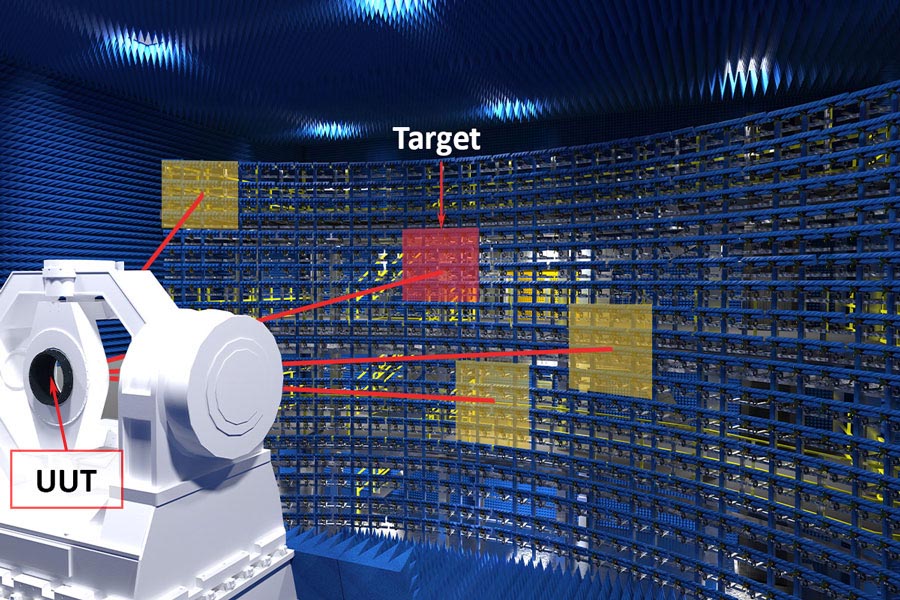
Simultaneous Targets
Real-Time Multi-Target Simulation
Simulate dynamic motion of multiple RF targets linked to scenarios, each operating independently in frequency, location, and signal strength for maximum flexibility.
High Precision Performance
Achieve angle-of-arrival accuracy up to 0.075°, supported by on-demand performance feedback and built-in test software for instantaneous monitoring and validation.
Versatile Operating Modes
Choose from Static, Dynamic, and Self-Test modes to accommodate a wide range of testing requirements and operational conditions.
Unlimited Motion Without Moving Parts
Enable virtually unlimited velocities and accelerations for multiple targets, with dynamic motion constrained only by frame rate and field of view (FOV).
Advanced Scenario Control
Targets can traverse the entire FOV within a single update frame and return in the next, allowing overlapping paths and complex interactions between targets.
Customizable Test Environments
Create unique test scenarios directly through the intuitive SG software interface, giving users complete control over testing conditions.
Broad Application Range
Perfect for developing new devices or sensors, or validating existing sensors against diverse target types and challenging conditions.
Three Purpose‑Built Operating Modes
Calibration Mode: Full control of every module for building accurate calibration tables and running built‑in test scripts.
Real‑Time Mode: The core mission mode, synchronizing target behavior with other HITL subsystems for live, frame‑by‑frame scenario execution.
Verification Mode: Ensures calibration accuracy and allows Real‑Time logic to be validated using the calibration hardware.
Components of a Real-Time RF Scene Generator™

Components of a Real-Time RF Scene Generator™

Anechoic Chamber
The chamber’s shielding level can be tailored to meet specific customer requirements. Purpose‑built to house the compact RFSG system, it delivers a true anechoic environment that ensures repeatable, tightly controlled test conditions. Integrated fire suppression and HVAC interfaces support safe, reliable, and continuous operation.


Array Wall
The Array Wall is a stable spherical (or cylindrical) structure that houses RF emitters and electronics. The RF emitters angular spacing is based on the requirements. The structure can be multi-level as dictated by the number of emitters.
RF Emitters
The RF emitter is designed to provide the precise illumination of the test zone. This includes the antenna radiation pattern shape, directivity, and efficiency. Each emitter provides the same level of high performance across the test system operating frequency bandwidth. Each RF emitter is design for a long operational life and is accessible from the Mezzanine and its own mechanical mounting bracket.


Flight Motion Simulator
The flight motion simulator (FMS) may be included as part of the test system to support the creation of user-controlled simulations of real-world RF environments. Motion of the FMS is coordinated with each RTSG test scene. Information may be passed from the Scene Generator workstation to the FMS.
Control Room
The Control Room is designed to house the Scene Generator RF rack and operator workstations, with direct visual access for rapid Go/No‑Go checks. It may be RF‑shielded separately from the anechoic chamber. A customer simulation computer can drive real‑time target motion with precise angle‑of‑arrival control. Our engineering team scales and customizes each system to customer needs.


RF Racks with Wiring
Wiring and cable systems deliver control, communication, and conditioned RF signals to the Real Time RF Scene Generator, with organized cable management improving functionality, safety, and aesthetics. RF racks house electronic modules that perform the signal conditioning needed to create the desired Test Zone illumination, while proper airflow ensures thermal control; the resulting signals are then distributed from the racks to the emitters on the Array Wall.
Shielded RF Cable Interface Panel
RF panels provide a means for cables to enter or exit a shielded enclosure. The size and complexity of the RF panel is determined by the quantify and types of cables and the desired location of the RF racks with respect to the Array Wall hardware.


Multi-floor Mezzanine with Material Lift
A rigid, stable mezzanine structure supports personnel and equipment requiring close access to the Array Wall hardware, electronics, and cabling, and may include multiple levels depending on chamber height and access needs. For efficient material handling, an optional material lift can be incorporated, along with safety gates and related features to ensure safe operation.
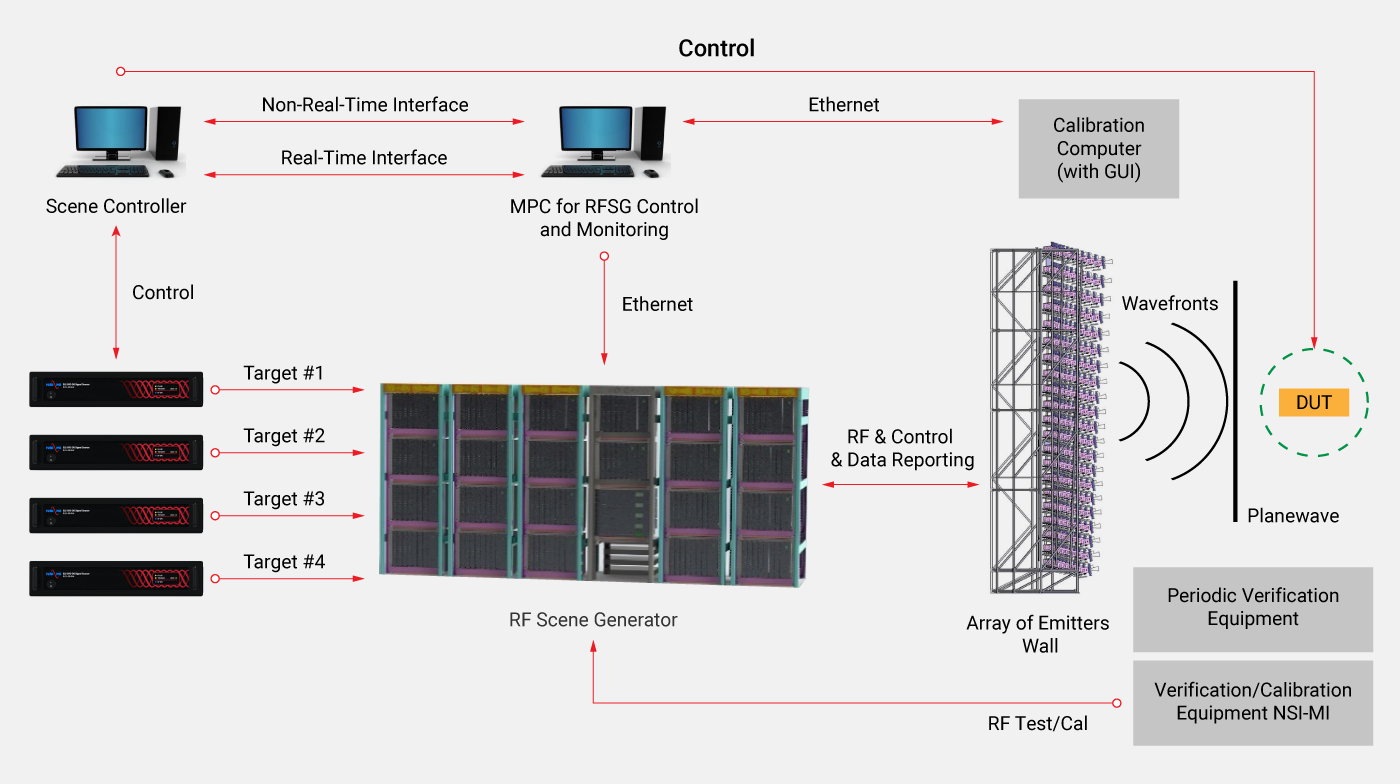
Block Diagram
Beamforming Technology
Our RF Signal Generator (RFSG) uses next-generation beamforming technology to deliver clean, accurate fields inside the Quiet Zone (QZ). Unlike traditional phased arrays, it consistently illuminates the QZ with the precise angle of arrival (AoA) and power level needed for high-fidelity testing.
At its core is a smart 4×4 subarray architecture that automatically selects 16 emitters and applies precise amplitude and phase adjustments to create controlled plane waves. Optimized emitter spacing reduces ripple and improves field accuracy, while additional rows and columns extend the field of view.
By positioning emitters close to the desired AoA, the RFSG ensures stable performance, minimizes RF drift, and delivers a cleaner, more consistent test field across the entire QZ.
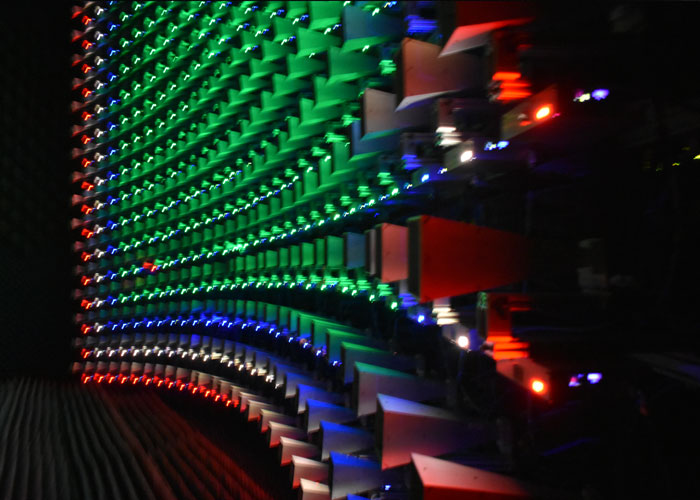

Dynamic Target Motion Simulation
The RFSG recreates smooth, realistic target movement across the field‑of‑view. By intelligently steering its beam within a subarray—and seamlessly transitioning to adjacent subarrays when larger motion is required—the system delivers the correct plane‑wave angle‑of‑arrival to the Quiet Zone at every frame. The result is highly authentic target behavior that matches complex test scenarios.
Consistent, Calibrated RF Power
Each target’s radiated power is precisely controlled through detailed calibration tables, ensuring consistent power‑flux density at the Quiet Zone for every frame. Power levels can be equalized across targets and frequencies, and dual‑gain modes support broader operating conditions. When scenarios require dynamic power variation, external signal modulation is fully supported.

-
Specifications
-
Applications
| Frequency Range | 2 to 18 GHz |
|---|---|
| Update Rate | 1 millisecond |
| Field of View (Az by El) | ±41.5˚ by ±23˚ |
| Quiet Zone Size (Spherical) | 30.5 cm (1-ft) diameter (2–15 GHz) 25.4 cm (10 in.) diameter (15–18 GHz) |
| EIRP | up to +40 dBm (2–12 GHz) up to +30 dBm (12–18 GHz) |
| Dynamic Range | ≥ 120 dB |
| Angle of Arrival Accuracy | 0.25° |
| Instantaneous Bandwidth | 1 GHz or 25% of Center Frequency |
| Polarization | Vertical or Horizontal Linear |
| Angular Rate | 0˚ to 50˚/s Az or El |
- Radar development & validation
- AESA/phased-array performance testing
- HITL and system-level testing
- Automotive radar / ADAS validation
- Electronic warfare & threat simulation
- Production calibration & QA
- Tracking algorithm development