




.svg?la=en&revision=cee9767f-8e72-4d76-a07a-14ba25688269&hash=ADF64722447408F8CA70B4436F59CB64)
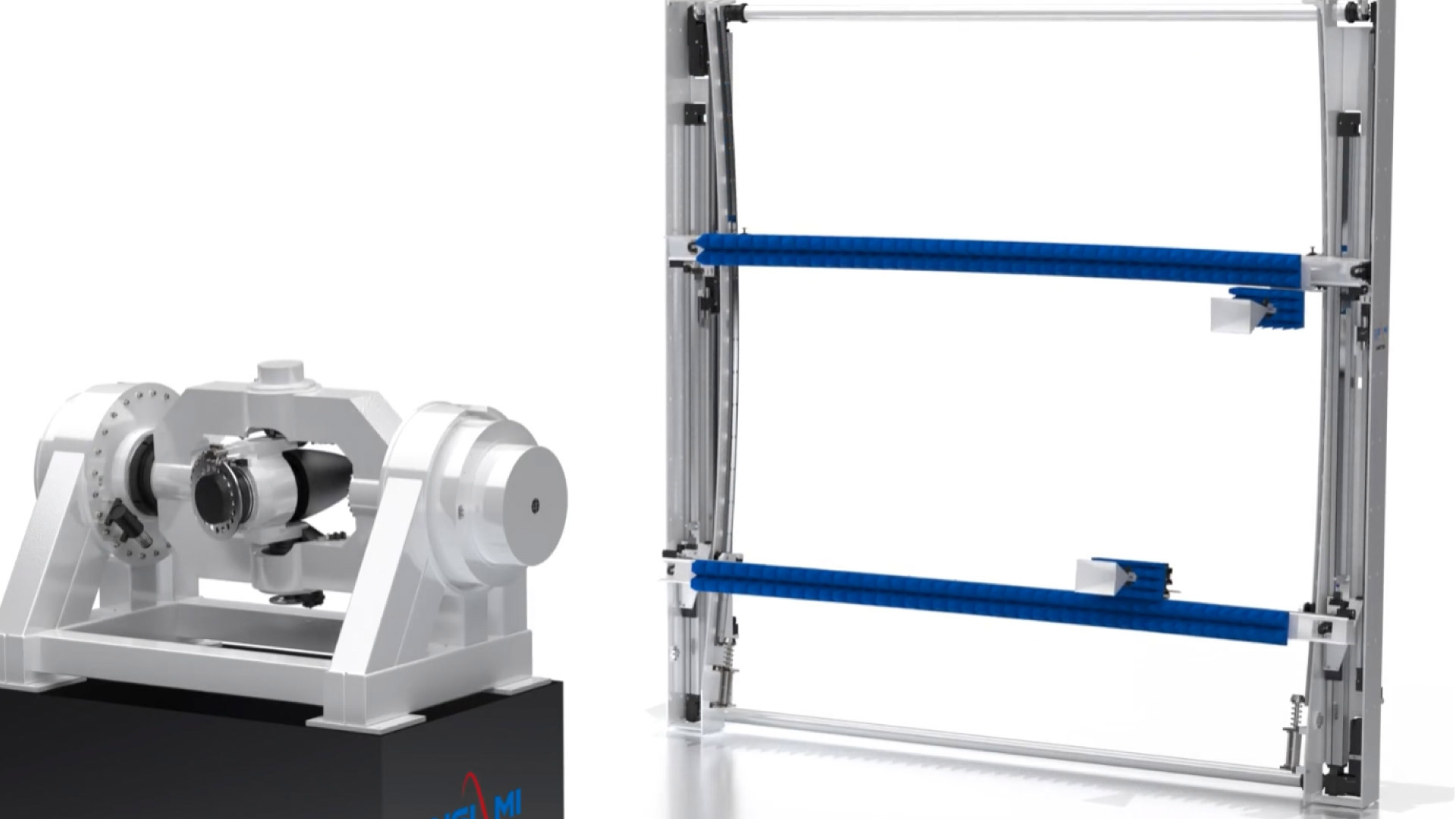
Mechanical RF Scene Generators™
Features
- Fast, accurate physical motion of multiple targets
- Generate scenes with a wide field of view
- Electric motors suitable for many applications
- At it’s limit, may require hydraulics for highest rates of acceleration
- Suitable for multi-target motion at lower dynamic rates
What is Mechanical RF Scene Generator™?
A Mechanical RFSG is the simplest implementation of RF target simulators. Target motion is created and presented to the DUT by electromechanically moving one or more emitters that represent targets along a spherical surface with the DUT at the focal pint of the sphere. The DUT may be mounted on a mechanical positioner as shown to coordinate motion with each RF scene. Overlapping multiple targets can’t be emulated. Keep out zones will be required to avoid collisions or occlusions.

Modes of Operation
Start Up Mode: Prepares the system for operation upon power application.Encoder Indexing Mode: Indexes each axis to find home positions and checks limit switches.
Local Mode: Default mode allowing user commands for positioning and diagnostics.
Simulation Mode: Responds to dynamic commands for real-time tracking of the moveable horn.
Limit Exceeded Mode: Engages safety protocols when a limit switch is triggered.
Park Mode: Safely shuts down the system by positioning components to a safe state.
Fault Mode: Suspends operations to prevent damage during critical faults.
Emergency Stop Mode: Immediately disables the system for safety.
Components of Mechanical RF Scene Generator™
X-Y Scanner
- 2 Curvilinear Vertical Rails
- 2 Curvilinear Horizontal Rails with carriage
- Manual roll positioner with coaxial rotary joint and horn attachment bracket
- Associated Motors, Drive Mechanisms and Encoders
- Cable Management Hardware
- Limit Switches and End Stop shock absorbers
- Absorber treatment


Curvilinear Horizontal Rails
Emitters, standard gain horns in the depicted system, are mounted on the spherical x-axis structures to maintain a constant radius to the DUT. In this example, the non-dynamic target is stationary and the dynamic target, which represents a decoy, is dynamically controlled by the software.
Position Control
The positioners are controlled by NSI-MI positioner controllers such as the ELE-PAC. A handheld local controller set is available.
Learn More

Software with GUI
The GUI is accessible via any browser on a Windows PC and provides command execution and status monitoring. Position information, including current and commanded positions, is displayed. Pre-programmed positioning commands are available for user convenience. Status information includes mode, activity, and fault notifications.
Physical Parameters
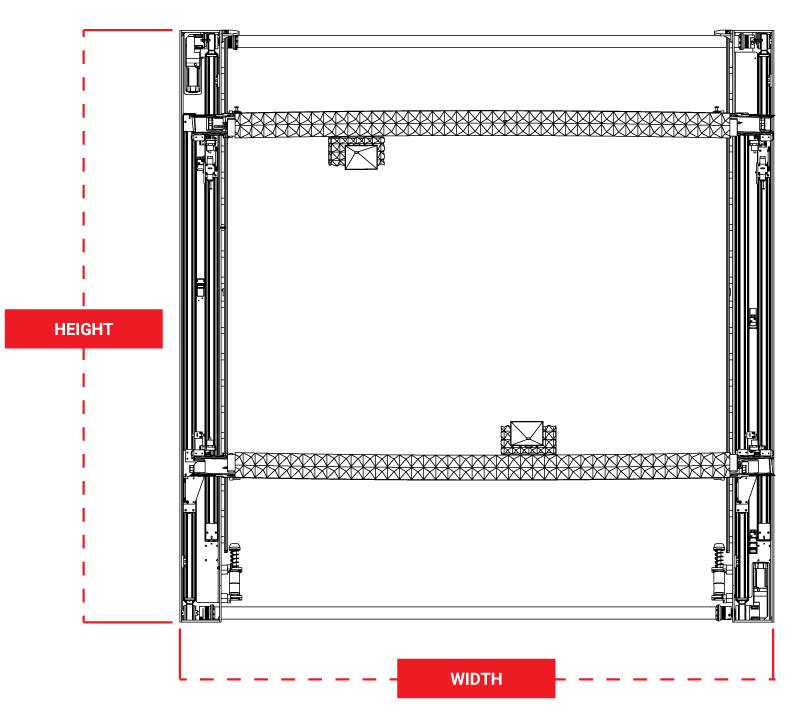
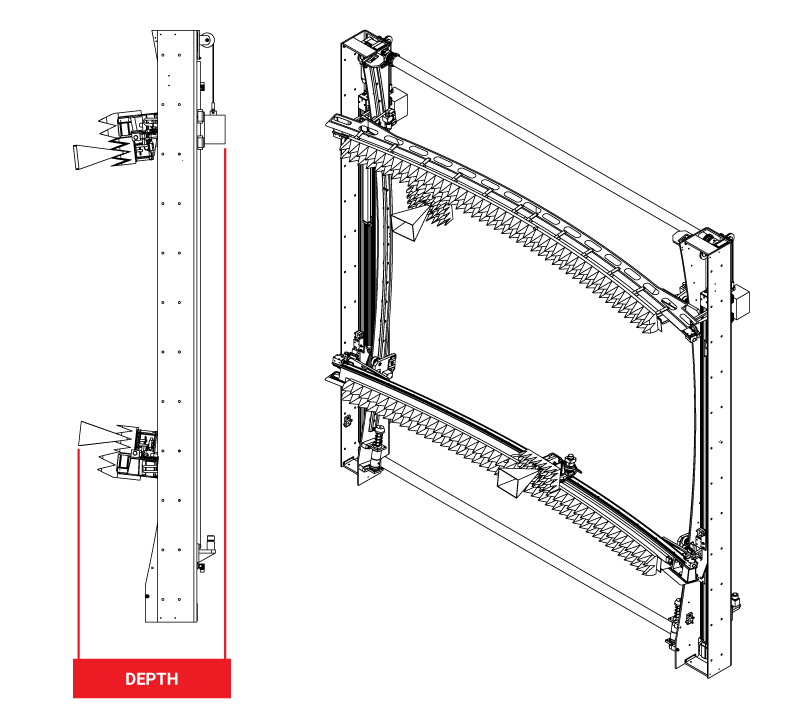
-
Example Specifications
-
Applications
| X-Position Specifications | Y-Position Specifications | |
|---|---|---|
| Positional accuracy | +/- 0.2 in. | +/- 0.5 in. |
| Resolution | 0.10 in. | 0.2 in. |
| Repeatability | +/-0.1 in. | +/-0.2 in. |
| Max speed | 32 in./sec | 24 in./sec |
| Max load | 1.0 lb | 1.0 lb |
| Minimum travel area | 10 ft x 10 ft | 10 ft x 10 ft |
- Radar development & validation
- AESA/phased-array performance testing
- HITL and system-level testing
- Automotive radar / ADAS validation
- Electronic warfare & threat simulation
- Production calibration & QA
- Tracking algorithm development